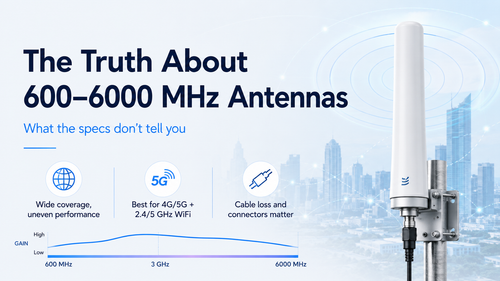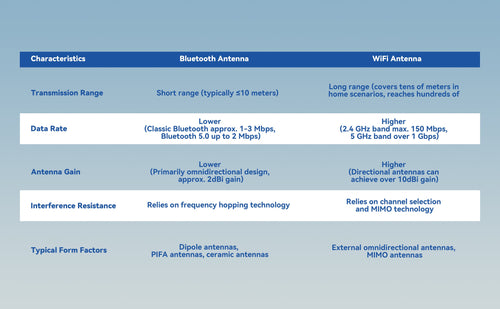
In the field of wireless communication, fiberglass antennas have gained prominence in outdoor and industrial settings thanks to their unique material properties and performance advantages. However, many users lack a systematic understanding of their strengths and weaknesses, which can lead to mismatches when selecting the right antenna. This article explores, from multiple dimensions — performance, environmental adaptability, cost and application scenarios — the pros and cons of fiberglass antennas, and provides practical advice to help you match the right antenna type to your needs.
1. Core Advantages of Fiberglass (FRP) Antennas
(A) Excellent signal‑transmission performance
High gain, long‑distance coverage: Fiberglass antennas often offer gains in the range of 5‑15 dBi, which is substantially higher than ordinary whip antennas (2‑5 dBi). For example, a 5.8 GHz fiberglass directional antenna can concentrate the radiation pattern to enable stable communication over several kilometres, making it suitable for wireless bridges, base stations and other long‑range links.
Strong frequency specificity, stable transmission: Many fiberglass antennas are designed for a specific band (for example 433 MHz, 2.4 GHz or 5.8 GHz). Within the target band, signal loss is low and transmission efficiency is higher. For instance, a 5.8 GHz fiberglass antenna used for drone video transmission may maintain a low VSWR (often ≤1.5) and reduce reflections, ensuring stable HD image streaming.
(B) Outstanding environmental adaptability
Weather‑resistant, suitable for extreme conditions: The shell of the antenna is often made of glass‑fibre‑reinforced plastic (FRP), which withstands UV, wind, rain, and wide temperature swings (‑40 °C to +80 °C) in outdoor, long‑duration deployments (such as mountaintop base stations or seaside monitoring stations). Its performance degradation over time is far less than conventional metal‑cased antennas.
Corrosion resistance and EMI robustness: FRP materials are electrically insulating and can reduce electromagnetic interference (EMI) effects on the internal metallic radiators. Meanwhile, the outer shell resists acidic/alkaline media, salt spray, and corrosive industrial atmospheres, making them ideal for oilfields, chemical plants and mining environments.
(C) Structural stability and long service life
High strength, impact tolerant: FRP composite materials can reach tensile strengths comparable to some metals and resist impact from wind, hail or mechanical vibration.
Integrated structure, fewer failure points: A well‑designed fiberglass antenna often integrates the outer shell and inner radiating elements in a sealed unit, thereby reducing loose joints (as might happen with whip antennas) and lowering maintenance frequency.
2. Main Disadvantages of Fiberglass (FRP) Antennas
(A) Higher cost, larger upfront investment
Material and manufacturing costs: Producing a fiberglass antenna typically involves the manufacture of the metallic radiator, fibre‑glass winding or moulding of the shell, curing, finishing and painting processes. The composite materials (glass fibre, resin) and equipment cost are higher. Thus the unit cost is significantly above that of simple whip antennas.
Customization costs rise quickly: If you require a specific frequency band or shell size/shape, tooling and R&D costs escalate, making small‑volume runs less economical.
(B) Reduced flexibility and more restrictive installation
Size and weight are larger: To achieve high gain and structural robustness, fiberglass antennas may be 30 cm or longer, with weight many times that of a small board‑mount antenna or whip. That limits their use in very compact or mobile devices.
Rigid mounting required: Because of the rigid composite shell, installation typically requires fixed supports or brackets, making them less suitable for cramped indoor spaces or applications where the antenna must flex or move.
(C) Frequency‑band adaptability can be limited
Many fiberglass antennas are single‑ or dual‑band. If your system requires multi‑band functionality (2.4 GHz + 5.8 GHz + sub‑GHz for example), you may need multiple antennas or a multi‑band design, which complicates installation, increases cost and may reduce elegance.
3. Selection Advice Based on The Pros & Cons
When you should opt for a fiberglass (FRP) antenna
Outdoor, long‑range wireless communication (such as wireless bridges, base stations, forest fire monitoring) where wind, rain, UV or other harsh conditions exist.
Industrial environments (oilfields, chemical plants, mining) requiring corrosion resistance, EMI robustness and low‑maintenance long‑life hardware.
Applications that demand both high signal stability and long service life, and where the initial budget allows for higher cost (e.g. drone video transmission over long distances, remote monitoring links).
When you might reconsider or choose an alternative
Consumer electronics (smartphones, Bluetooth speakers) where size, cost and flexibility are paramount — simpler PCB or spring antennas may be more appropriate.
Indoor, short‑distance wireless links (e.g., indoor APs, smart‑home devices) where standard omnidirectional antennas suffice at much lower cost.
Multi‑band devices where a single antenna must cover many disparate frequencies — a conventional multi‑band antenna might offer more flexibility than multiple fixed‑band fiberglass units.
4. Summary
A fiberglass (FRP) antenna is in many ways a double‑edged sword: its high gain, strong weather tolerance and long life make it nearly indispensable in demanding outdoor and industrial scenarios. Yet these same advantages bring higher cost, reduced flexibility and often single‑band limitation, which restrict its suitability in other contexts. When selecting, align the antenna’s attributes with your requirements: if you need robust, stable, long‑distance performance and are prepared to invest upfront, a fiberglass antenna is a top‑tier choice; if you prioritise cost, compactness and flexibility, a standard antenna may serve you better.
Looking for a high‑quality fiberglass antenna? Consider BOOBRIE’s line of fiberglass‑shell antennas — engineered for outdoor durability, high gain and long service life.
BOOBRIE 915MHz 3dBi Indoor Omni-Directional Fiberglass Antenna
BOOBRIE 915Mhz 5.8dBi Outdoor Omni-Directional Fiberglass Antenna
BOOBRIE WiFi Antenna 2.4GHz 3dBi Outdoor Omni-Directional Fiberglass Antenna
BOOBRIE Dual Band WiFi Antenna 2.4GHz/5.8GHz 3dBi Outdoor Omni-Directional Fiberglass Antenna