Antennas look deceptively simple—sometimes it’s just a metal rod or a printed trace on a PCB. But that “simple” structure is doing a very specific job: it converts energy that is confined inside a circuit (voltage/current on a transmission line) into energy that can travel through space (an electromagnetic wave), and it can do the reverse on reception.This article explains the bottom-layer logic of communication antennas—without heavy math. Once you understand the chain from fields → waves → signal processing, antenna selection, installation, and troubleshooting become far less mysterious.
1) The core idea: an antenna is a transformer between circuits and space
A practical way to think about an antenna is as an energy interface. On one side is guided energy on a feed structure (coax, microstrip, twin-lead). On the other side is radiated energy in free space. The antenna’s geometry controls how efficiently and in what “shape” that energy leaves the device.
A key property is reciprocity: for most passive antennas, the transmit pattern and receive pattern are the same. If an antenna is good at sending energy in a direction, it’s also good at listening from that direction.
2) From alternating current to electromagnetic waves
When RF current flows, the fields around a conductor don’t stay still:
· A time-varying voltage creates a time-varying electric field (E-field).
· A time-varying current creates a time-varying magnetic field (H-field).
· Changing E and H fields sustain each other and can detach from the antenna as a propagating wave.
Near field vs far field
Close to the antenna is the near field, where energy can be stored and exchanged (like a spring). Farther away is the far field, where energy behaves like a wave carrying power outward. Most “communication range” problems are really far-field problems (propagation + link budget), while most “tuning” problems are near-field problems (matching + resonance).
Wavelength and electrical length
Antennas are sized relative to wavelength. The basic relationship is:
λ = c / f
where λ is wavelength, c ≈ 3×10⁸ m/s (speed of light), and f is frequency.
A very common starting point is a quarter-wave (λ/4) or half-wave (λ/2) radiator. For example, at 2.4 GHz, λ is about 12.5 cm, so λ/4 is about 3.1 cm in free space. Real antennas often look shorter because of loading, dielectric effects, and folding.
Resonance: why some lengths “just work”
When an antenna is near resonance, current and voltage distributions form standing waves that support strong radiation. Off-resonance, much of the energy is stored and then sent back toward the source instead of being radiated—showing up as reflection (high VSWR).
The missing half: return path and ground plane
Many real antennas are only “half” the structure you see. A quarter-wave monopole, for instance, expects a ground plane (or counterpoise) to complete the current path. If the ground plane is too small—or if the feed/connector layout forces current onto the cable shield—performance can collapse even when the antenna itself is fine.
3) From wave back to signal: what happens on reception
Reception is the same physics in reverse. An incoming electromagnetic wave imposes an E-field on the antenna. That field drives charges in the conductor, creating a small RF voltage and current at the feed point. Because this signal can be extremely weak, the first stages after the antenna (matching network, filters, and LNA) are just as important as the radiator itself.
A complete signal path, end to end
It helps to picture the full “bits → air → bits” chain:
Digital data → modulation → RF upconversion → power amplifier → matching network → antenna → free-space wave
→ antenna → matching/filtering → low-noise amplifier → downconversion → demodulation → digital data
4) The knobs you can turn: key antenna parameters (and what they really mean)
|
Parameter |
What it describes |
Why you should care |
|
Impedance & VSWR |
How well the antenna/load matches the feed system (often 50 Ω). |
Mismatch reflects power back, reducing range and stressing RF stages. |
|
Gain (dBi) |
How concentrated the radiation is in a direction (not “free power”). |
Higher gain extends range in favored directions but narrows coverage. |
|
Radiation pattern |
The 3D “shape” of coverage (omni vs directional, beamwidth, sidelobes). |
Determines where your signal is strong/weak—critical for placement. |
|
Polarization |
Orientation/rotation of the E-field (vertical, horizontal, circular). |
Mismatch causes large losses; circular helps with rotation/mobility. |
|
Bandwidth |
Frequency range where matching and pattern remain acceptable. |
Wideband needs different structures; narrowband can be smaller/more efficient. |
|
Efficiency |
How much accepted power is actually radiated (vs lost as heat). |
Small or heavily loaded antennas can have low efficiency even if VSWR looks OK. |
Impedance matching & VSWR in one minute
Most RF systems are designed around 50 Ω. If the antenna’s input impedance differs, part of the power reflects. VSWR is a convenient way to express that mismatch. As a reference point, VSWR = 2.0 means roughly 11% of the power is reflected (about 89% delivered), which is often acceptable—but not ideal for maximum range.
Gain and pattern: “focus” vs “coverage”
Gain doesn’t create energy; it redistributes it. An omnidirectional antenna spreads energy around the horizon for general coverage. A directional antenna focuses energy into a beam, increasing signal in that direction at the expense of other directions—like a flashlight compared with a bare bulb.
Polarization: the antenna has an orientation
If the transmit antenna is vertically polarized but the receive antenna is horizontal, they are (nearly) orthogonal. That can cost on the order of 20–30 dB in real systems—often the difference between “works” and “dead.” In environments where the device rotates (satellites, drones, wearable), circular polarization can improve reliability.
Bandwidth: why ‘multi-band’ is hard
An antenna is a resonant structure, so it naturally prefers a limited band. Wideband or multi-band designs use techniques like multiple resonances, log-periodic structures, or carefully shaped ground/slots. The trade-off is usually size, complexity, or efficiency.
Efficiency and the quiet villains: loss and detuning
A perfectly matched antenna can still be a poor radiator if it’s lossy or detuned by its surroundings. Common culprits are small ground planes, plastic/metal enclosures, hand effects, long thin feed traces, and high-loss cables. Matching fixes reflection; it does not magically remove loss.
5) What happens in the real world: propagation and fading
Once energy leaves the antenna, the channel becomes the boss. Free-space path loss grows rapidly with distance, and indoor/urban environments add reflection, diffraction, and absorption.
Multipath in plain language
Signals rarely travel on just one path. They bounce off walls, vehicles, and the ground, arriving with different delays and phases. Sometimes they add up (strong signal), sometimes they cancel (deep fade). This is why moving an antenna just a few centimeters can dramatically change RSSI.
MIMO and beamforming (why modern Wi‑Fi/5G feel ‘smarter’)
With multiple antennas, a system can exploit multipath instead of suffering from it. MIMO uses spatial diversity to improve throughput and robustness. Beamforming adjusts phases across an array to steer energy—a controlled version of the interference effect described above.
6) Practical takeaways: choosing and using antennas without guesswork
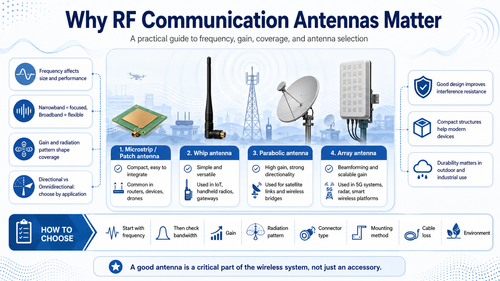
1. Start with the band(s): frequency drives size, matching, and regulatory constraints.
2. Decide coverage: omni for multi-direction coverage, directional for point‑to‑point range.
3. Respect polarization: keep TX/RX aligned; consider circular for rotating devices.
4. Treat the ground plane as part of the antenna—especially for monopoles and PCB antennas.
5. Keep feed losses low: short cables, low-loss coax, clean connectors, minimal adapters.
6. Measure when possible: a VNA or simple VSWR meter quickly tells you if you’re fighting mismatch.
7. Troubleshoot systematically: placement → connectors/cable → matching/VSWR → interference → radio settings.
A quick troubleshooting map
If range suddenly drops, check in this order:
1) Connector loosened / adapter added
2) Cable damaged or bent sharply
3) Antenna moved closer to metal or inside an enclosure
4) Polarization/orientation changed
5) Interference increased or channel changed
6) RF front-end power/filters/settings changed
Conclusion
Communication antennas are not magic—they’re controlled physics. Once you see them as a transformer between circuits and space, the “bottom logic” becomes clear: energy conversion, resonance, matching, and the geometry‑driven shape of radiation. From there, real-world performance comes down to propagation, installation, and loss management.
At BOOBRIE, we build antennas, coax assemblies, and RF connectivity accessories with these fundamentals in mind—so you can spend less time guessing and more time shipping reliable wireless products.
FAQ
Q: What does a communication antenna do?
A: It converts RF energy on a feedline (guided current/voltage) into electromagnetic waves that can travel through space—and converts incoming waves back into an electrical signal for your receiver.
Q: Do antennas “create” more power or signal?
A: No. Antenna gain only redistributes energy. A higher-gain antenna focuses energy in some directions and reduces it in others.
Q: Why does antenna length matter so much?
A: Because most antennas are sized relative to wavelength. When the electrical length is near resonance (often ~λ/4 or ~λ/2), radiation is more efficient and reflections are lower.
Q: What is VSWR, and what’s a good value?
A: VSWR describes how well the antenna impedance matches the system (typically 50 Ω). Lower is better; many practical systems aim for ≤2:1 in-band, and better if you need maximum range or efficiency.
Q: Does a higher‑gain antenna always increase range?
A: It can, if the link is primarily limited in one direction and you can align the beam. But if you need 360° coverage, or if fading/multipath dominates, a moderate‑gain omni or diversity/MIMO may perform better.
Q: Why does performance drop when the antenna is inside a device enclosure?
A: Nearby plastic, metal, batteries, and ground planes can detune the antenna, change the pattern, and add loss. Placement and a stable counterpoise/ground reference matter as much as the antenna itself.
Q: Can I extend the antenna with a longer coax cable?
A: Yes, but cable loss increases with length and frequency. Use the shortest practical run and a lower-loss coax when you must extend—especially above 1–2 GHz.
Q: Can Wi‑Fi and Bluetooth antennas be shared?
A: Often yes, because both commonly use 2.4 GHz. But bandwidth, matching, and the device environment still matter—so validate performance in your real enclosure and layout.