Swarm proved that tiny, power-limited devices could stay visible far beyond terrestrial coverage. Starlink is now moving that idea into a much larger LTE and mobile-operator ecosystem. Here is what changed, what did not, and what hardware teams should watch next.

INFORMATION | August 28, 2026 | BOOBRIE
Starlink made low-Earth-orbit satellite broadband familiar. Swarm tackled a quieter problem: how to keep a remote sensor, buoy, valve, or shipping container online when it only needs to send a few bytes at a time.
Those two networks started with very different hardware and business models. After SpaceX acquired Swarm in 2021, however, their paths began to converge. The destination is not simply a faster version of Swarm. It is a broader satellite-to-cellular platform in which orbiting payloads behave more like mobile base stations and ordinary cellular IoT hardware becomes part of the satellite ecosystem.
That shift matters to anyone building equipment for agriculture, maritime operations, energy, logistics, environmental monitoring, or emergency response.
The short version: Swarm proved the demand for low-cost, low-power satellite telemetry. Starlink is scaling the same market through LTE standards, mobile-network partners, a much larger constellation, and a wider device ecosystem.
Satellite IoT Is Not Satellite Broadband
A remote camera and a soil-moisture sensor are both "connected devices," but they do not need the same network.
A broadband terminal is designed for continuous, high-volume traffic such as video calls, cloud applications, and large file transfers. A field sensor may send only a location, temperature, battery level, or alarm code every few minutes or hours. For that sensor, throughput is rarely the first design priority. Power, cost, antenna size, coverage, message delivery, and years of unattended operation matter more.
That is why satellite IoT deserves its own engineering path.
|
Network approach |
Typical endpoint |
Traffic profile |
Hardware priority |
|
Starlink broadband |
Homes, vessels, aircraft, businesses |
High-volume, continuous IP traffic |
Throughput, low latency, stable power, clear sky view |
|
Satellite-to-mobile |
Existing phones and supported cellular devices |
Messaging, app data, voice, expanding broadband |
Compatibility with operator spectrum and device standards |
|
Narrowband satellite IoT |
Sensors, trackers, meters, remote controllers |
Small, infrequent messages |
Low energy, low cost, compact antenna, long field life |
What Swarm Proved
Swarm was built around a deliberately modest link.
In 2019, the US Federal Communications Commission authorized Swarm to operate a 150-satellite non-voice, non-geostationary mobile-satellite service constellation in low Earth orbit. Its licensed system used VHF spectrum, including 137-138 MHz for downlink and 148-149.95 MHz for uplink.
The M138 modem made the concept tangible. The archived product manual describes a compact module with a 1 kbps link and a maximum packet size of 192 bytes. That is nowhere near enough for ordinary internet use, but it is enough for:
-
GPS coordinates and asset status
-
Temperature, pressure, moisture, or water-level readings
-
Battery voltage and equipment health
-
A short alarm or exception code
-
A periodic heartbeat confirming that a remote system is alive
The important lesson was economic as much as technical. A low-data satellite link can create real value if the alternative is having no visibility at all. One reliable alert from a remote pump, refrigerated container, or flood gauge may be more valuable than gigabytes of routine data.
Figure 1. The architectural shift is from a dedicated short-packet satellite modem and VHF link toward a cellular network model with broader device and operator integration. The illustration is conceptual, not a hardware compatibility diagram.
Why Swarm Was Useful to SpaceX
When SpaceX acquired Swarm, it gained more than a small constellation. It gained a team that had already worked through the less glamorous parts of satellite IoT: short-message protocols, power-limited terminals, device provisioning, field deployment, industrial customers, and regulatory approvals.
Swarm also filled a product gap. Traditional Starlink terminals were excellent for broadband, but oversized for a battery-powered sensor that sends a handful of readings per day. Swarm showed how satellite connectivity could reach machines that could never justify a broadband dish, its energy budget, or its service cost.
The legacy VHF platform was not likely to become SpaceX's only long-term IoT architecture. In 2023, Swarm stopped selling new VHF devices, according to customer communications reported by TechCrunch and Via Satellite. At the same time, SpaceX was building a much larger route to the same market: Starlink Direct to Cell, now presented as Starlink Mobile.
The New Route: A Cellular Base Station in Orbit
The central idea behind Starlink's satellite-to-mobile system is easy to explain, even if it is difficult to engineer: put cellular base-station capability on a satellite, use a mobile operator's licensed spectrum, and integrate the satellite network much like a roaming partner.
SpaceX says its first-generation Direct to Cell satellites use an advanced eNodeB payload, custom silicon, phased-array antennas, and software designed to handle problems that terrestrial towers do not face. The satellite moves at orbital speed, so the system must compensate for Doppler shift, timing variation, rapid beam movement, and handovers. At the other end of the link, the phone or modem has limited transmit power and antenna gain.
The backhaul is different too. Traffic can move from the cellular payload through laser links across the Starlink constellation and then into the operator network. That allows the space segment to extend terrestrial coverage rather than operate as an entirely separate consumer service.
SpaceX's 2025 progress report says the first generation of this constellation grew to more than 650 satellites. Its current Starlink Mobile page describes service across six continents and a future V2 platform intended to increase throughput and support a more terrestrial-like 5G experience. Those numbers show the scale advantage of placing IoT capability inside a larger satellite and launch system.
What Starlink Has Actually Published for IoT
It is important to separate confirmed compatibility from future possibilities.
Starlink's published Direct to Cell material says the IoT service is designed to work with off-the-shelf CAT-1, CAT-1 bis, and CAT-4 modems that comply with 3GPP Release 10 or newer and support the operating bands used in the intended country. SpaceX also reported successful data tests with CAT-1 IoT devices.
That is a meaningful change from Swarm. A dedicated satellite modem can give way to cellular hardware that is already familiar to device makers, distributors, certification labs, operators, and industrial customers.
However, it does not mean that every LTE modem can automatically connect to a satellite. Real availability still depends on:
-
A Starlink mobile-network partner in the country
-
Regulatory approval for the relevant service and spectrum
-
A supported modem category and band combination
-
SIM, roaming, network, and commercial provisioning
-
A suitable antenna system and a sufficiently open view of the sky
-
Firmware and application behavior that can tolerate intermittent satellite conditions

In other words, "standard hardware" reduces integration friction; it does not remove system engineering.
Where 3GPP NTN Fits - and Where It Does Not
3GPP Release 17 brought non-terrestrial networks into the standards roadmap and included work for NB-IoT and eMTC over satellite links. This is important because it gives the wider cellular industry a common framework for timing, mobility, architecture, and device behavior outside terrestrial coverage.
But Release 17 NTN support and Starlink's currently published CAT-1/CAT-1 bis/CAT-4 compatibility are not identical claims.
NB-IoT and eMTC are optimized for low-power, lower-throughput machine communications. CAT-1-class devices offer a different balance of bandwidth, complexity, power, and installed ecosystem. Over time, satellite IoT may support several cellular categories. For a product being designed today, the correct question is not "Does it support NTN?" in the abstract. It is:
Which modem category, band, operator profile, firmware version, and country approval are supported by this specific service?
That question prevents a great deal of expensive rework.
Where Satellite IoT Creates the Most Value
Satellite IoT works best when the data is small, the asset is important, and terrestrial coverage is unreliable or absent.
Maritime monitoring
Buoys, fishing vessels, unmanned surface craft, offshore equipment, and environmental sensors can report position, weather, battery state, or alarms without a continuous broadband session.
Agriculture and remote land management
Soil sensors, weather stations, irrigation controllers, livestock trackers, and equipment monitors can remain visible across large properties where building cellular infrastructure is impractical.
Energy and utilities
Pipelines, valves, tanks, pumps, mines, and remote generation sites often need dependable exception reporting more than constant high-speed data.
Logistics and cold chain
Containers and mobile assets move through ports, rural roads, borders, and ocean routes. Satellite connectivity can fill the gaps between terrestrial networks and preserve an asset history.
Environmental and emergency systems
Flood gauges, wildfire sensors, weather stations, and disaster-response equipment become especially valuable when terrestrial networks are damaged or unavailable.

Figure 2. Remote IoT performance depends on the entire RF installation: modem, supported band, antenna placement, cable loss, weather sealing, power budget, and software behavior.
The Engineering Challenges Have Not Disappeared
Small messages do not make the radio link easy.
Power budget
A device may sleep for most of the day and then draw a much higher current during acquisition and transmission. Battery sizing must use the real duty cycle, retry behavior, temperature range, and worst-case satellite visibility - not only the modem's sleep-current figure.
Link budget and antenna placement
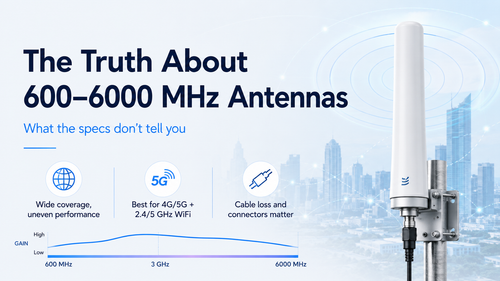
Satellite devices need a usable view of the sky. Enclosures, metal roofs, machinery, terrain, vegetation, and an incorrectly oriented antenna can consume the available margin quickly. A higher advertised antenna gain does not automatically solve poor radiation geometry.
Cable and connector loss
Every decibel matters in a constrained uplink. Use the shortest practical RF cable, select cable loss at the actual operating frequency, avoid unnecessary adapters, and verify connector type and gender before deployment. Outdoor assemblies also need strain relief, sealing, and corrosion control.
Mobility and network timing
The satellite and its beam move quickly. Doppler compensation, handover, timing, and retry logic are core system functions, not edge cases. The application must also cope with variable availability and longer delays than a typical urban cellular link.
Regulation, roaming, and certification
Satellite-to-cellular service uses licensed spectrum and operator relationships. A tracker that crosses borders may face different band plans, approvals, roaming rules, and data requirements in each market.
Security and device lifecycle
Remote industrial devices can remain deployed for years. Secure identity, key storage, firmware updates, access control, and failure recovery should be designed in from the start. A globally reachable device with weak lifecycle controls is not resilient.
A Practical RF Checklist for Product Teams
Before choosing an antenna, cable, or connector for a satellite-connected IoT prototype, confirm these points:
-
Service and country: Identify the exact operator partner and approved service area
-
Modem and category: Verify the supported CAT class, firmware, bands, and provisioning route
-
Antenna requirements: Match the operating band, polarization, radiation pattern, ground-plane needs, and installation orientation
-
Cable loss: Calculate attenuation at the real frequency and keep the run as short as the mechanical design allows
-
Connector interface: Confirm family, gender, polarity, mating cycles, sealing method, and strain relief
-
Power profile: Test sleep, acquisition, transmit peaks, retries, and cold-temperature battery performance
-
Sky visibility: Validate the final enclosure and mounting position in representative field conditions
-
Fallback behavior: Decide what the device stores, retries, or reports when the satellite link is temporarily unavailable
BOOBRIE supplies RF antennas, coaxial cables, connectors, and custom cable assemblies for wireless and communication projects. Component selection must always be based on the modem manufacturer's specifications, local frequency plan, and target installation. A cable or antenna that works well in one cellular band is not automatically suitable for another satellite IoT service.
What to Watch Next
The most useful Starlink IoT announcements will not be broad promises of "global coverage." Product teams should watch for operational details:
-
Countries and operators with commercial IoT access
-
Exact supported modem models, categories, and bands
-
Power consumption and attach time under real satellite conditions
-
Message, IP, and application behavior during coverage gaps
-
Certification paths for fixed and mobile industrial devices
-
Pricing, roaming, and fleet-management tools
-
The effect of Starlink Mobile V2 on capacity and device compatibility
These details will determine whether satellite-to-cellular connectivity becomes a specialist backup link or a standard option inside mainstream industrial IoT products.
Final Takeaway
Swarm's most important contribution was not speed. It proved that a tiny message from a remote machine could justify a dedicated satellite network.
Starlink is now pursuing the same need at a different scale. The network is moving from proprietary VHF short packets toward LTE devices, mobile-operator spectrum, roaming-style integration, laser backhaul, and a much larger constellation. The result could make satellite connectivity easier to add to ordinary industrial hardware - but only when modem support, spectrum, antenna design, power, certification, and field installation are treated as one system.
The next phase of satellite internet will not only connect more people. It will make remote machines more observable, manageable, and useful.