Why RF Communication Antennas Matter
An RF communication antenna sits at the front end of a wireless link. It converts electrical signals into electromagnetic waves in space, and it also receives wireless signals and sends them back into the system. Routers, smartphones, IoT devices, base stations, drones, and satellite equipment all rely on antennas. Compared with low-frequency antennas, RF antennas are shaped much more directly by frequency. Frequency affects size, coverage, gain, interference resistance, and installation conditions.
1. Frequency sets the size and many of the performance limits
As frequency goes up, wavelength gets shorter. That is why antennas can usually be made smaller at higher frequencies. For example, a quarter-wave antenna at 300 MHz is much larger than a quarter-wave antenna at 5 GHz. This explains a common rule in antenna design. Lower-frequency antennas are often longer and better suited for longer-distance links or scenarios that need stronger penetration. Higher-frequency antennas are easier to fit into compact products, which is why phones, wearables, and drones often use smaller RF antennas.
2. Narrowband and broadband designs serve different jobs
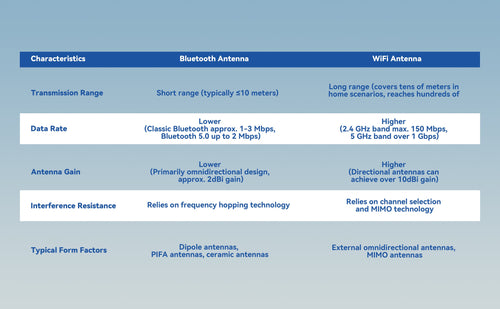
Some antennas are built for one band or a very narrow range. These narrowband antennas often deliver better efficiency inside their target band. Other antennas are designed to cover several bands at the same time, such as 2.4 GHz and 5 GHz. These broadband antennas are a better fit for WiFi, Bluetooth, and multi-standard devices. Neither approach is always better. Narrowband designs are more focused. Broadband designs are more flexible. The right answer depends on what the product actually needs to do.
3. Gain and radiation pattern shape real coverage
Gain describes how well an antenna concentrates energy in useful directions. Lower-gain antennas usually spread coverage more widely. Higher-gain antennas focus more energy into a narrower area, so they can often improve distance and signal quality when the direction is correct. That is why indoor devices, outdoor bridges, point-to-point links, and satellite systems use very different antenna forms. When choosing an antenna, it is not enough to look only at the dBi number. You also need to check whether the radiation pattern matches the real application.
4. Directional or omnidirectional is one of the most important choices
Directional antennas push energy toward a target area. They are a strong choice for backhaul links, long-distance bridges, radar, and communication paths that are already known. Omnidirectional antennas provide broader coverage around the device. They work well for gateways, mobile terminals, and sensor networks with many nodes. For many buyers, this is the first big question: do you need longer reach in one direction, or balanced coverage all around?
5. A good RF antenna must handle interference well
Real RF environments are crowded. WiFi, Bluetooth, cellular networks, industrial equipment, and nearby metal structures can all affect performance. A well-designed antenna reduces unwanted interference through polarization strategy, impedance matching, grounding design, and in some cases beam control or filtering. The result is direct and practical. Signal reception becomes cleaner, communication becomes more stable, and the device performs more reliably in real installation conditions.
6. Compact structure is a major advantage in modern products
Many RF antennas, especially higher-frequency designs, benefit from miniaturization. Microstrip and patch antennas can be integrated into PCBs or compact modules. Flexible antennas can be attached to curved surfaces. This matters a lot in smart hardware, where internal space is limited but wireless performance still matters. Good antenna design makes that balance possible.
7. Environmental durability is part of antenna quality
Antennas do not work only in laboratories. Outdoor and industrial antennas must also deal with high heat, low temperatures, rain, salt spray, vibration, and mechanical shock. Because of that, housing materials, sealing performance, connector quality, and mounting stability are just as important as frequency coverage. A truly reliable RF antenna needs both electrical performance and physical durability.
8. Common RF antenna types and where they are used
Microstrip and patch antennas are common in compact electronic devices. Whip antennas have a simple structure and are widely used in sub-GHz systems and many general wireless products. Parabolic antennas are strong in high-gain and long-distance directional coverage. Array antennas support more advanced beam control and are widely used in 5G and radar systems. Each antenna type solves a different system problem, so selection should start from the application, not only from the shape.
How to choose the right antenna for a project
Start with the operating frequency. Then look at bandwidth, gain, radiation pattern, connector type, mounting method, feed cable loss, and the working environment. At the same time, think clearly about what the product needs most: omnidirectional coverage, directional transmission, compact integration, or outdoor durability. Good antenna selection never depends on one parameter alone. It comes from balancing RF performance with real use conditions.
Final thoughts
An RF communication antenna is not just a simple accessory. It is a critical part of the wireless system. Once you understand how frequency, bandwidth, gain, directionality, interference control, and structural design work together, antenna selection becomes much clearer. For brands, installers, and end users, that understanding leads to more stable links, better communication quality, and a more reliable product experience.
Quick Guide to Common RF Antenna Types
| Type | Main Features | Typical Bands | Common Uses |
|---|---|---|---|
| Microstrip / Patch | Compact, easy to integrate, moderate gain | 2.4 GHz, 5 GHz, mmWave | Routers, devices, drones, embedded systems |
| Whip | Simple, low cost, wide practical use | 433 MHz, 868 MHz, 915 MHz, cellular | IoT, handheld radios, gateways |
| Parabolic | Very high gain, strong directionality | Microwave to mmWave | Satellite links, long-distance wireless bridges |
| Array | Beamforming, scalable gain, advanced control | 3.5 GHz, 28 GHz and above | 5G systems, radar, smart wireless platforms |