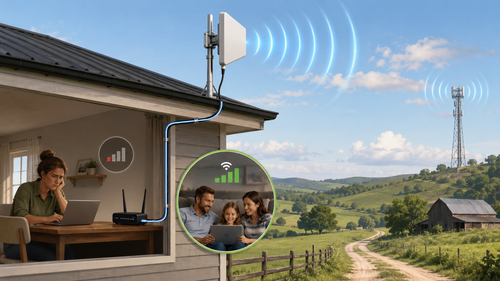
In any wireless system, the antenna is not just an accessory. It is the component that turns RF energy on a conductor into electromagnetic waves in the air, and back again at the receiving side. Many buyers focus on chipsets, modules, or output power first, but antenna choice often has a direct impact on coverage, range, stability, and interference performance.
Communication antennas come in many forms. The differences are not only about shape. They also involve radiation pattern, operating band, polarization, installation environment, and the real job the antenna needs to do. This guide gives BOOBRIE readers a practical overview of the main antenna categories and where each one fits best.
1. The first big split: omnidirectional vs. directional antennas
The most useful starting point is to ask one simple question: where do you want the signal to go?
Omnidirectional antennas
An omnidirectional antenna is designed to provide broad horizontal coverage, usually across 360 degrees in the azimuth plane. In practice, that does not mean equal power in every direction in three-dimensional space. The pattern is closer to a donut shape: wide around the horizon, but more limited vertically.
This is why omnidirectional antennas are common in routers, handheld radios, mobile devices, vehicle installations, outdoor gateways, and many IoT deployments. They are easy to deploy because they do not require precise aiming. They work well when devices are spread around the antenna, when terminals move, or when one antenna needs to serve multiple directions.
The trade-off is that omni antennas spread energy more broadly. For that reason, they usually do not offer the same focused reach as a high-gain directional antenna in a point-to-point link.
Directional antennas
A directional antenna concentrates more energy into a defined direction. That usually means higher gain, better long-distance performance, and improved control over where the signal goes. The price of that extra focus is that alignment matters much more.
Common directional antenna styles include panel antennas, Yagi antennas, parabolic dish antennas, and sector antennas. These are often used in wireless bridges, fixed links, backhaul systems, outdoor CPEs, and infrastructure deployments that need controlled coverage instead of all-around coverage.
If the goal is a point-to-point link, a focused coverage zone, or lower interference outside the target area, a directional antenna is often the better choice.
2. Classification by structure: the shape usually hints at the job
Whip antennas
Whip antennas are slim, rod-like antennas commonly used on routers, radio modules, handheld terminals, and vehicle systems. They are usually omnidirectional and are popular because they are simple, affordable, and effective for general wireless coverage.
Fiberglass antennas
Fiberglass antennas are widely used outdoors. Their radomes are built for weather resistance, which makes them a common choice for industrial sites, agricultural monitoring, base installations, marine environments, and outdoor IoT networks.
Panel antennas
Panel antennas are normally directional. Their flat profile makes them easy to mount on walls, poles, and building exteriors. They are widely used for wireless bridges, surveillance links, and outdoor fixed wireless equipment.
Yagi antennas
Yagi antennas use a driven element together with a reflector and one or more directors. They remain a classic solution for directional reception and transmission, especially when a focused beam is needed over longer distances.
Parabolic dish antennas
Parabolic antennas use a curved reflector to focus energy into a narrow beam. They are a familiar choice for microwave backhaul, satellite communication, and very long-distance point-to-point links.
Patch, PCB, and embedded antennas
These antennas are often built into compact electronics such as smart devices, trackers, wearables, modules, and small gateways. Their advantage is integration and small size. Their challenge is that performance can depend heavily on the enclosure, ground plane, nearby materials, and overall product design.
3. Classification by frequency: the band changes everything
Antennas are also classified by operating frequency. This matters because frequency affects antenna size, propagation behavior, path loss, penetration, and regulatory use.
Lower-frequency antennas are often physically larger, but they can offer better diffraction and longer reach in many scenarios. Higher-frequency antennas can be smaller and support higher-capacity communication, but they are usually more sensitive to obstacles and installation conditions.
In real-world communication products, common bands and application areas include 433 MHz, 868 MHz, 915 MHz, 1.2 GHz, 2.4 GHz, 5 GHz, 5.8 GHz, and wider application families such as LTE, 5G, GNSS, Wi-Fi, Bluetooth, LoRa, and other ISM-related systems.
That is why antenna selection should never be based on appearance alone. The first checkpoint is always frequency matching. If the antenna does not match the actual operating band, the advertised gain number will not save the link.
4. Classification by polarization: often overlooked, often critical
Polarization describes the orientation of the radiated electric field. The most common types are vertical, horizontal, and circular polarization.
Vertical polarization is common in many mobile and omnidirectional systems. Horizontal and vertical polarization can also be used deliberately in fixed links for separation and system design. Circular polarization is common in some drone video systems, satellite links, and applications where orientation changes matter.
If the transmitter and receiver do not use compatible polarization, link performance can drop sharply. That is why polarization should be checked together with frequency, connector type, and mounting style.
5. Classification by application: where theory becomes buying logic
Base stations and wide-area coverage
These deployments usually prioritize coverage control, capacity, and reliability. Sector antennas, omnidirectional base antennas, and multi-band integrated antennas are common options.
Point-to-point bridges
When two buildings or sites need a dedicated long-range wireless path, high-gain panel antennas, dish antennas, or Yagi antennas are typical candidates.
Vehicle and mobile installations
Cars, trucks, vessels, and moving equipment normally benefit from omnidirectional antennas because position changes constantly. Mechanical durability, sealing, and mounting method matter here as much as RF performance.
IoT and low-power long-range communication
LoRa, remote metering, agricultural sensing, and industrial monitoring often use fiberglass omni antennas, magnetic-mount antennas, or compact external antennas. In these projects, link budget, mounting height, and environmental fit usually matter more than chasing the biggest gain number.
Consumer electronics and embedded devices
Wi-Fi, Bluetooth, smart home devices, security products, and portable electronics often rely on whip antennas, FPC antennas, PCB antennas, or embedded patch-style solutions. In many of these products, the real challenge is not simply buying an antenna. It is making the antenna work well inside the full device structure.
6. What really matters when choosing a communication antenna
A buyer may start by asking whether an antenna should be omni or directional, but that is only the first filter. A useful antenna choice also depends on several other factors:
-
Whether the frequency band truly matches the device
-
Whether the gain is appropriate for the link instead of just sounding impressive
-
Whether the beamwidth matches the coverage target
-
Whether the polarization matches the system design
-
Whether the connector is correct, such as SMA, RP-SMA, or N-type
-
Whether the antenna is meant for indoor or outdoor use
-
Whether cable loss, cable length, and installation method will affect final performance
In many projects, the antenna is only one part of the result. Mounting position, cable loss, nearby metal, enclosure materials, and ground conditions can all change real performance. The most professional approach is to evaluate the antenna, the installation, the environment, and the device as one system.
Conclusion
There is no single best communication antenna. A larger antenna is not automatically better, and a higher gain number is not automatically smarter. Every antenna type is a trade-off among coverage, directionality, size, cost, and installation conditions.
If this article can be reduced to one sentence, it is this: start with the application, confirm the frequency and installation conditions, and then choose the antenna type that fits the job.