
Meta Description:
Mirror frequencies (images) are one of the most common annoyances in SDR. While IQ imbalance inside the receiver is the main cause, your antenna’s impedance mismatch makes it much worse. Here’s what’s really happening.
Introduction: The Ghost Signals That Shouldn’t Be There
You tune your RTL‑SDR or HackRF to 100 MHz. You see a strong signal. Then you also see a weaker copy at 110 MHz – even though nothing is transmitting there. Or you hear a voice from 440 MHz appear faintly on 430 MHz.
These are mirror frequencies (also called images). They are not real signals. They are artifacts caused by imperfections in the receiver’s quadrature (I/Q) downconversion.
Many SDR users blame poor filtering or cheap hardware. But there is another factor that is rarely discussed: your antenna’s impedance mismatch can significantly degrade the IQ balance and make mirrors much worse.
In this article, we’ll look at:
-
How orthogonal sampling works – and where it breaks
-
Why IQ imbalance creates mirror frequencies
-
How antenna VSWR adds “hidden cost” to mirror rejection
-
What you can do to reduce images without buying a new SDR
1. Orthogonal Sampling: The Foundation of Modern SDR
Most SDRs use a quadrature downconverter. The incoming RF signal is split into two paths:
-
I (In‑phase) – mixed with a local oscillator (LO) at 0°
-
Q (Quadrature) – mixed with the same LO but shifted by 90°
Mathematically, the complex baseband signal is:
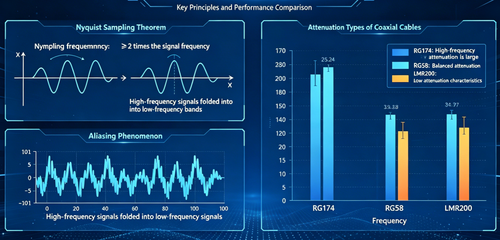
This complex sampling allows us to distinguish between positive and negative frequencies. As a result, a sampling rate of can handle a bandwidth of Hz (not ), because we are sampling the complex envelope, not the real signal.
For example, at a sampling rate of 2.4 MHz, an SDR can see from MHz to MHz relative to the LO frequency.
Ideal world: I and Q paths are perfectly matched in gain and phase. Mirror rejection is infinite.
2. Real World: IQ Imbalance Creates Images
In physical hardware, the I and Q paths are never perfectly identical. There are two types of imbalance:
Gain imbalance – the amplitude of I and Q differ (e.g., 1% difference)
Phase imbalance – the 90° shift is not exact (e.g., 89° instead of 90°)
Let’s model a single tone at frequency . In an ideal receiver, the complex output is:
With gain imbalance (where ) and phase imbalance , the output becomes:
The first term is the desired signal. The second term is the mirror (image) at frequency . That second term should be zero in an ideal world – but it is not, because of and .
Key result: The mirror rejection ratio (IMR) in dB is approximately:
Where is in radians. For example:
-
1% gain imbalance → about 40 dB rejection
-
2° phase imbalance → about 33 dB rejection
In cheap SDRs, IMR is often only 25–35 dB. That means a strong signal at +1 MHz will create a ghost (mirror) at -1 MHz that is only 25–35 dB weaker – clearly visible on the spectrum.
3. The Hidden Cost: Your Antenna’s Impedance Mismatch Makes It Worse
Now the part most people miss.
The IQ imbalance inside your SDR is fixed (determined by the chip and PCB layout). But the effective imbalance seen by the system changes when the antenna does not present a perfect 50Ω match.
Why? Because the RF front‑end (LNA, mixers) is designed assuming a 50Ω source. When your antenna has a high VSWR (e.g., 2:1 or more), the reflected energy changes the load impedance seen by the mixer. This load variation can modify both the gain and the phase of the I and Q paths unequally.
In simpler words:
A bad antenna turns a small, fixed IQ imbalance into a larger, frequency‑dependent imbalance.
Let’s look at a concrete example:
| Antenna VSWR | Return Loss (dB) | Additional Gain Imbalance | Additional Phase Imbalance | Mirror Rejection Degradation |
|---|---|---|---|---|
| 1.2:1 | -20.8 dB | negligible | <0.5° | <1 dB |
| 2:1 | -9.5 dB | 0.2–0.5 dB | 2–5° | 5–10 dB worse |
| 3:1 | -6.0 dB | 0.5–1.0 dB | 5–10° | 10–20 dB worse |
Real‑world observation: An SDR with a factory IMR of 35 dB (good enough) might drop to 25 dB IMR when connected to a poorly matched wideband antenna that has VSWR >2.5:1 across the band.
That 10 dB loss means the mirror is three times stronger (in linear power). A barely visible ghost becomes an obvious false signal.
4. How to Diagnose Antenna‑Caused Mirrors
You can test whether your antenna is contributing to image problems:
-
Replace the antenna with a 50Ω dummy load. If the mirrors disappear, the problem is external (antenna or cable).
-
Swap to a known low‑VSWR antenna (e.g., a well‑tuned 915 MHz LoRa antenna on its designed band). If mirrors improve, your previous antenna had poor match.
-
Look at the frequency dependence. If the mirror level changes dramatically when you tune across the band, your antenna VSWR is likely varying.
5. What You Can Do to Reduce Mirrors
Low‑cost (free):
-
Make sure your antenna is resonant on the frequency you care about. A 2.4 GHz WiFi antenna used at 900 MHz will have terrible VSWR → more mirrors.
-
Check all connectors – a loose SMA or RP‑SMA creates impedance bumps.
Medium cost:
-
Add a low‑noise amplifier (LNA) with good return loss at the antenna. The LNA isolates the SDR’s mixer from antenna reflections.
-
Use a band‑pass filter before the SDR. It attenuates out‑of‑band signals that could otherwise create strong mirrors.
Better antenna – the real fix:
A well‑matched antenna does not “magically fix” the SDR’s internal IQ imbalance. But it prevents the imbalance from being amplified by load mismatches.
BOOBRIE antennas are factory‑tested for VSWR <1.5:1 on their specified bands. For example:
-
Our 915MHz 3dBi LoRa antenna (RP‑SMA Male): VSWR ≤1.3 at 915 MHz
-
Our 4G/5G wideband 600‑6000MHz outdoor antenna: VSWR ≤1.8 across the whole range
-
Our dual‑band 2.4/5.8GHz WiFi antenna: VSWR ≤1.5 on both bands
With a properly matched antenna, your SDR can achieve the mirror rejection its designers intended – without extra filters or LNAs.
6. Final Thought: Don’t Blame the SDR Alone
Mirror frequencies are frustrating, but they are not purely the SDR’s fault. The antenna is part of the system.
A cheap SDR with a great antenna often outperforms an expensive SDR with a bad antenna – especially in mirror rejection.
Before you buy another SDR, check your antenna’s VSWR. You might find that a 200 receiver upgrade.
Related BOOBRIE products for cleaner SDR reception:
Have you experienced strange mirror frequencies that went away after changing the antenna? Share your story in the comments or tag #BOOBRIE_SDR on social media.
Subscribe to our blog for more deep dives into RF fundamentals – from quadrature sampling to antenna physics.